Black Friday & Cyber Monday Preparation: Launching Your Brand’s Custom Merch Drop
Moody2026-10-30T13:17:55+03:00Black Friday lands on November 27 this year, with Cyber Monday on November 30. If you run a Shopify store, a boutique gym, a CrossFit box, or a streetwear label, you already know the BFCM trap: the pressure to discount everything, the thinner margins that follow, and a cart abandonment rate that stays stubbornly high anyway.
There is a better lever than another sitewide percentage-off banner. A well-planned e-commerce merch drop built around custom socks gives you a low-cost, high-margin product that raises order value, rewards your best customers, and carries your brand into their daily routine long after the sale ends.
Here is the strategic breakdown.
1. The AOV Challenge: Why Flat Discounts Hurt and Checkout Add-On Products Help
Sitewide discounting is a blunt instrument. A 20% markdown applies to every order, including the customers who would have bought at full price. You give away margin on your most motivated buyers and train shoppers to wait for the next sale.
The smarter goal for BFCM is to increase AOV in e-commerce without cutting price across the board. That is where checkout add-on products earn their place. The best ones share four traits:
- Low landed cost, so the add-on is profitable even when discounted or given away
- High perceived value, so the customer sees a $20 item, not a $3 one
- Small and light, so shipping costs barely move
- Brandable, so every unit works as marketing
Custom crew socks check all four boxes. They are one of the few high margin retail products that feel like a gift, ship in a poly mailer, and need no sizing drama. As a Cyber Monday upsell, they sit comfortably at the “why not?” price point where shoppers add one more item rather than abandon the cart to comparison shop.
Illustrative math (your numbers will vary): a store with 2,000 BFCM orders at a $78 AOV that offers 15% off sitewide gives up about $23,400 in discounts. If instead a “Spend $100, get free custom socks” offer nudges 600 of those orders up to the threshold, you add roughly $13,200 in revenue and spend about $2,100 on the socks. One approach gives margin away; the other buys revenue.
2. Step-by-Step ROI: What Bulk Custom Socks Actually Earn
Let’s use a working assumption of $3.50 per pair at volume and a $18 to $22 retail price at checkout. Your actual unit cost depends on design complexity, color count, and order quantity, so treat this as a model to plug your own quote into.
Step 1: Unit margin.
- Retail Price: $18
Cost: $3.50
Gros profit per pair: $14.5
Gros margin: 80.6% - Retail Price: $20
Cost: $3.50
Gros profit per pair: $16.5
Gros margin: 82.5% - Retail Price: $22
Cost: $3.50
Gros profit per pair: $18.5
Gros margin: 84.1%
Step 2: Stress-test with landed cost.
Add freight, duties or brokerage if relevant, and inbound handling. At a conservative $4.25 landed cost and an $18 price, margin is still about 76%. That is how you land at the 75%+ benchmark even before you get optimistic about pricing.
Step 3: Model a realistic sell-through, including unsold units.
Scenario A, online store: Order 400 pairs at $3.50 ($1,400). Sell 250 pairs at $20 ($5,000). Even if you write off the entire order cost, you net $3,600, a 72% margin on revenue. The 150 unsold pairs become evergreen inventory, gift-with-purchase stock, or a post-holiday restock offer.
Scenario B, boutique gym or CrossFit box: Order 120 pairs ($420). Sell 90 to members at $20 ($1,800) and gift 30 to new sign-ups and referrals. Net after full order cost: $1,380, a 76.7% margin, plus 30 walking ads in the gym.
Step 4: Remember the gross-versus-net caveat.
These figures exclude payment processing, platform fees, packaging, and ad spend. Even so, very few categories give retailers this much room. For gym merchandise ideas that do not require carrying sizes in five cuts, socks are hard to beat.
3. The Sustainable Edge: Organic Cotton Custom Socks vs. Cheap Promo Items
Most promotional products for online stores end up in a drawer or a landfill. Thin polyester prints and low-grade print-on-demand socks fade, pill, and lose shape after a few washes. Customers notice, and they attribute that quality to your brand.
Organic cotton custom socks change the equation:
- A properly constructed knit holds its shape, color, and cushioning through repeated wash cycles, so your logo stays on someone’s feet for seasons, not weeks.
- Sustainable appeal. Eco-conscious shoppers across the US and Canada increasingly look for materials claims they can trust. Organic cotton gives you a concrete, credible story for your product page, your packaging insert, and your social content.
- Real design depth. Custom knit socks weave the design into the fabric rather than printing on top of it. Logos, patterns, and colorways are part of the sock itself, which reads as premium.
- Brand equity. A sock people are proud to wear is branded retail merch that earns its keep. A flimsy giveaway quietly does the opposite.
This is the core difference between custom apparel manufacturing done for quality and promo-item sourcing done for price. For boutique brands where perception is the product, it matters.
4. Smart Holiday Merch Bundles and Checkout Triggers
The product is half the strategy. Placement and offer design are the other half.
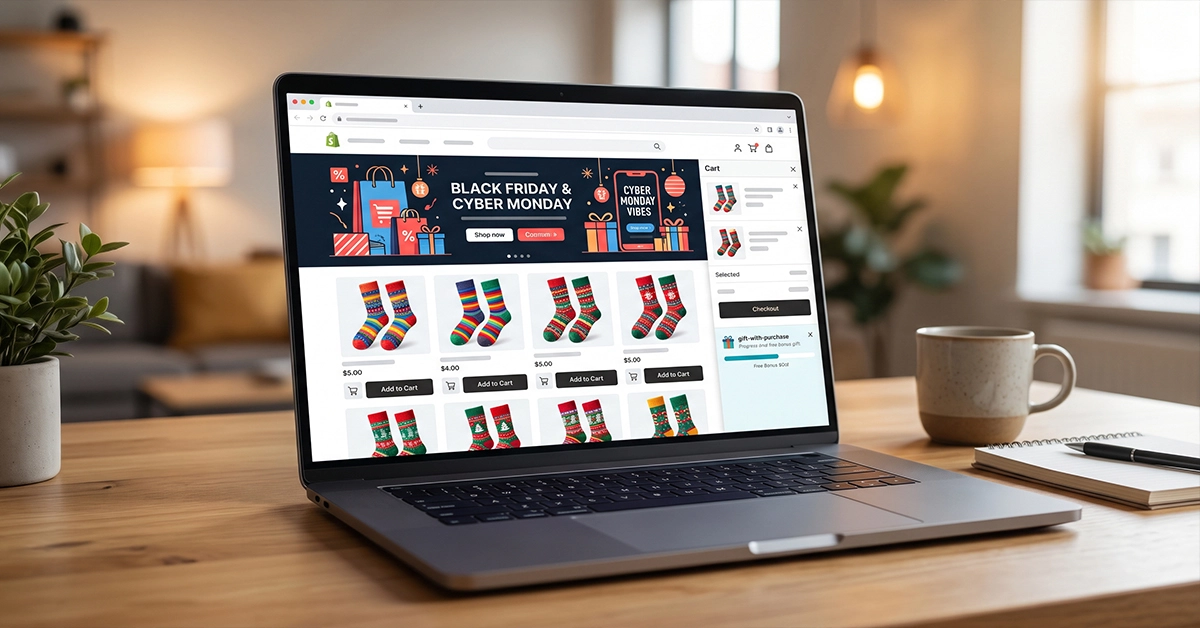
Slide-cart upsells. Add your branded socks to the cart drawer as a one-click “complete the look” item. Price it at $18 to $22, or show a small BFCM-only bundle price such as two pairs for $34. Impulse purchases happen when friction is lowest, and a cart drawer is as low as it gets.
“Spend $100, Get Free Custom Brand Socks.” A gift-with-purchase threshold set modestly above your current AOV is one of the cleanest ways to increase AOV in e-commerce while protecting your price integrity. Use a progress bar in the cart (“You’re $14 away from free custom socks”) so the incentive is visible at the moment of decision. Because your cost is roughly $3.50 to $4.25, the GWP is far cheaper than an equivalent percentage discount.
Mystery holiday bundle boxes. Pair a limited-edition sock colorway with two or three of your best-selling accessories or small-batch items and sell it as a surprise gift box. Mystery bundles lift perceived value, help you move slower inventory, and create shareable unboxing content. For gyms, add a free class pass or a protein sample.
Limited drop framing. Name the sock design, number the run (“Holiday Drop, 500 pairs only”), and tease it before BFCM to your email and SMS lists. Scarcity does more for conversion than a deeper discount ever will.
For gyms and studios: use in-studio signage, QR codes at the front desk, and member-only early access on the Wednesday before Black Friday. Boutique store swag doubles as a retention tool when it goes into new-member welcome kits.
5. Q4 Production and Logistics: A Realistic Timeline Check
Here is the honest part. Custom knit production is not same-week work, and the calendar is tight. Black Friday is November 27, and shipping carrier cutoffs for guaranteed pre-holiday delivery arrive in mid-December. Confirm exact production lead times and shipping windows with your manufacturer and carrier, because they vary by quantity, design complexity, and season. As a planning framework:
- Now: finalize your design brief and quantities. Lock the logo files, colorways, and size ranges (a single size range or a one-size-fits-most approach simplifies things).
- Request mockups immediately. Virtual mockups let you approve the look quickly without waiting on a physical sample.
- Order physical samples if your timeline allows. Check fit, cushioning, and color accuracy. If you are short on time, approve on mockups and test on a small first run.
- Approve the production schedule in writing. This is the step that actually secures your slot, because Q4 capacity fills quickly.
- Plan freight and receiving. Whether you are importing into Canada or shipping within the US, build in a buffer for transit and for your own warehouse receiving and kitting.
If your production window cannot realistically land before November 27, do not give up on the opportunity. Launch the drop as a Cyber Week or December gifting campaign, take pre-orders with a clear ship date, and use BFCM to build the waitlist. A well-timed pre-order often performs as well as in-stock inventory because the buyer already knows what is coming.
For US and Canada merchants: whether you are sourcing custom knit socks in the US or custom socks for Canada, check cross-border shipping rules, duties, and bilingual labeling requirements early so nothing stalls at receiving.
The Bottom Line
Black Friday does not have to mean racing to the bottom on price. A Black Friday custom merchandise strategy built around durable, organic cotton custom socks gives you a high-margin add-on, a customer-friendly gift, and a branded product that keeps working for you into the new year.
Ready to Launch Your Merch Drop?
Do not leave this to the last week of November. Visit sockssprites.com to upload your logo, request free virtual mockups, and lock in your custom organic cotton sock production schedule before the Black Friday and Cyber Monday inventory cutoffs close.