Beating the Q4 Rush: Why Smart Procurement Managers Plan Holiday Merch in August
Moody2026-08-21T16:05:31+03:00It’s August. Your holiday client-gift line item isn’t due for another four months, so it’s still sitting at the bottom of the priority list. If you’re a procurement lead, that instinct is understandable and it’s also the single most expensive assumption you’ll make all year.
Custom corporate merch isn’t a retail purchase. It’s a manufacturing project with a queue, a proofing cycle, and a shipping network that gets more expensive and less reliable the closer you get to December. The buyers who lock in their custom socks now aren’t just “getting ahead” they’re avoiding a very real, very quantifiable cost curve. Here’s the operational case for ordering in Q3.
The Factory Queue Doesn’t Wait for Your Budget Cycle
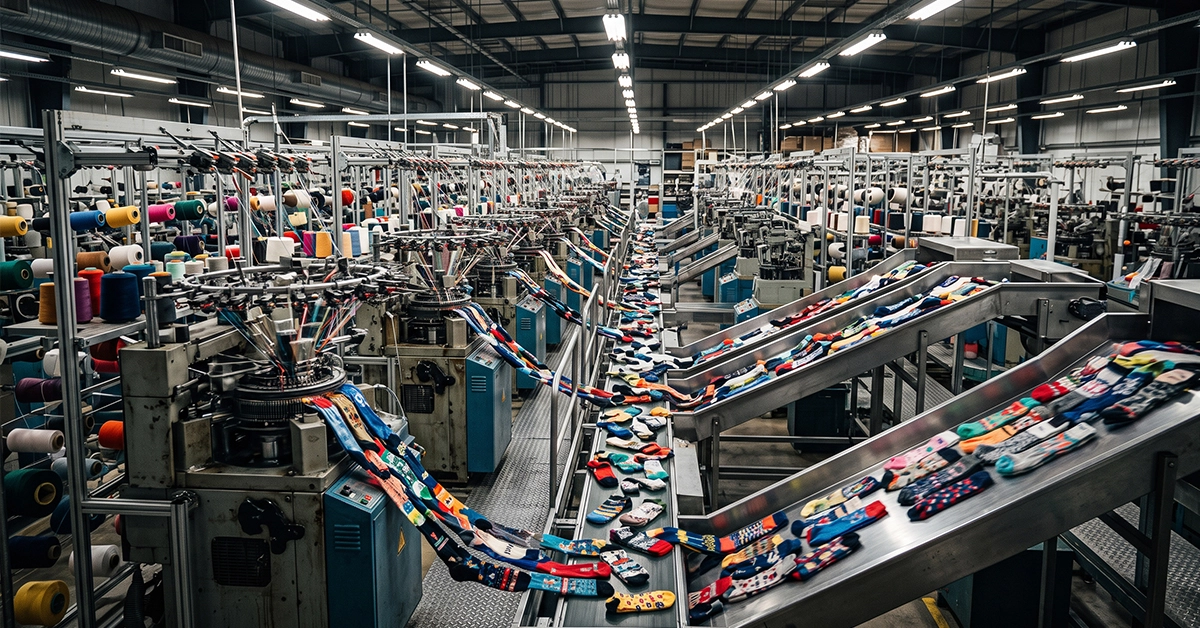
Custom Jacquard-knit socks aren’t pulled off a shelf they’re built to order. Producing a branded pair with your logo woven directly into the fabric (not printed, not embroidered) involves a distinct sequence:
- Digitizing the design into a Jacquard knit pattern the machines can read
- Machine setup and calibration for your specific colorway and yarn blend
- A physical sample run for your approval
- Full production, which is scheduled into a shared factory queue alongside every other client’s order
Every step in that chain competes for the same machine time. In Q3, factories are running normal capacity. By late October and November, they’re absorbing the entire industry’s holiday demand at once corporate gifting, event swag, sports teams, and retail restocks all hit the same production calendar simultaneously. When a queue fills up, orders don’t get rejected; they get pushed, rushed, or upcharged. An August order rides the calm water. A November order rides the surge.
Peak Shipping Surcharges Are Already Locked In
This part isn’t a projection it’s published carrier policy, and it applies to every business shipping through the winter.
For the 2025–2026 season, UPS is applying peak surcharges to all domestic shipments starting October 26 through January 17, running $0.40 to $0.60 per package on Ground and Ground Saver services, and $1.10 to $2.05 per package on Air services, with the highest rates landing in the November 23–December 27 window. On top of that, Additional Handling, Large Package, and Over Maximum Limits surcharges increase starting September 28 and stay elevated through mid-January.
FedEx runs a parallel structure: its 2025–2026 Demand Surcharge program kicks in for high-volume shippers, calculated weekly against a summer baseline, with charges applying from late October through mid-January and recalculated dynamically based on shipping behavior.
Translate that into procurement terms: the exact same order costs more to ship in November than it does in August and that’s before you factor in the added risk of delivery delays during the industry’s highest-volume weeks.
Vector Proofing Without the Pressure
A rushed proof is where logo mistakes happen the wrong Pantone match, a size that reads wrong at 1 inch instead of 6 feet, a design that looks crisp on screen but muddies in a woven knit. Jacquard knitting has real technical limits (color count, stitch density, minimum line weight) that a good vector proof accounts for.
When you start in August, your team gets real breathing room to:
- Review proofs against brand guidelines without a countdown clock
- Request revisions without triggering rush fees
- Test a physical sample before committing to a full production run
- Loop in stakeholders (marketing, brand, legal) without a scheduling scramble
None of that is possible when your first proof lands in the same week your gifts are supposed to ship.
Guaranteed Inventory Beats Hopeful Inventory
Every factory has a finite amount of machine time between now and December. Booking a production slot in August means your yarn, your colorway, and your capacity are reserved. Booking in November means you’re competing for whatever capacity is left and “sold out” is a real answer custom manufacturers give once their calendar fills.
For procurement teams managing employee appreciation gifts, client packages, or event merchandise with a fixed delivery date (a holiday party, a year-end mailer, a January kickoff), that certainty is the entire point of planning ahead. A locked production slot removes the single biggest variable in the whole project: will it actually arrive on time?
The Math, Simplified
Order in August | Order in November | |
Factory queue | Standard capacity | Peak-season backlog |
Proofing timeline | Relaxed, revision-friendly | Compressed, rush-fee territory |
Shipping cost | Standard rates | Peak surcharges layered on top |
Delivery certainty | Locked production slot | Subject to remaining capacity |
Rush fees | None | Common industry practice |
The product doesn’t change. The price and the risk do.
The Takeaway for Procurement Leads
Q4 corporate gifting isn’t a December problem it’s a Q3 decision. The factories, the carriers, and the calendar all reward buyers who move early, and they all penalize the ones who don’t. If holiday client gifts, employee appreciation kits, or year-end merch are anywhere on your 2026 roadmap, August is the window to lock in design, proofing, and production before the queue fills and the surcharges kick in.
Socks Sprites builds custom Jacquard-knit socks for corporate gifting, employee swag, and client merch from vector proof to doorstep. If Q4 is on your radar, let’s talk timelines now, while there’s still room in the queue.